

People who have a seat at the table are in the room when key strategic decisions are made.
Their input and opinions are valued because they are regarded as strategic, not tactical. They see beyond their own area of responsibility and understand how the various phases of the business cycle are connected to each other, forming what we call The Transaction Cycle. This cycle is described in Chapter 11 of our book Becoming a Strategic Leader.
This concept is so important we wanted to provide you with an additional detailed example of model’s application.
Here we discuss two dynamics necessary to move closer to coveted “seat at the table” status. The first is being able to understand and appreciate the “big picture.” The second is knowing with certainty how and where you add strategic value so that you can expertly manage the entire transaction.
Regardless of the work you do, your efforts are part of a business transaction. The transaction might be relatively simple or profoundly complicated. But all transactions have five distinct phases, phases that we have graphically depicted. Each phase requires unique personality strengths to competently complete them. When you have a big picture perspective, you think more strategically about the entire transaction and how to manage all phases of the process.
Let’s look at an example that illustrates our point.
Assume you work in training and development and the SVP of Sales asks you to develop and then deliver a selling skills training program; the executive team is under pressure to grow revenue.
Phase One: Innovation
Phase One is the design of the training experience using applied imagination, creativity and originality. Due diligence is necessary to understand how the company is positioned in the marketplace, what skills need improvement, what top performers are doing differently, how salespeople add strategic value to client relationships, etc. The most important skill in this phase is generating ideas, exploring options and posing questions that cause senior management to re-think or consider a new perspective.
Brainstorming and asking deep questions will begin to create the framework for the training. You want your internal customers (the SVP and sales leaders) to feel energized and challenged when you ask questions that cause them to think differently – thus changing their perception of you.
Phase Two: Presentation
Phase Two is influencing and persuading; initiating contact and interpersonal interaction. This is when you deliver dynamic pitches to promote the upcoming experience. The most important skill in this phase is extroversion – selling ideas with passion, energy and enthusiasm.
This phase considers various ways to frame your message so that sales managers and salespeople will be excited and motivated about the training event. The objective is to generate enthusiasm and for participants to believe this will be a unique opportunity to develop professionally.
Phase Three: Partnering
Phase Three is open communication, collaborating, listening, empathizing and seeking a win-win dynamic. The most important skill in this phase is being able to internally partner by obtaining management input and support when developing the specifics of the curriculum.
Key managers can make or break a training initiative. By soliciting the contribution and participation of line managers, they’ll feel more engaged and willing to take ownership. They’ll undoubtedly bring you ideas and insights that will help you to create a more robust event. The perception of you will transform when line managers see, perhaps for the first time, that they have a real training partner to help their people become more successful.
Phase Four: Delivery
Phase Four is following through to manage the entire project effectively. The most important skill in this phase is conscientiousness; the ability to execute and deliver on what has been promised. This is where the rubber meets the road, where every detail, from coffee to technology, must be expertly managed.
Here, each aspect of the program is examined and structured so the entire event is flawlessly delivered. Detail analysis, developing processes, logistics, flow charts and timetabling are coordinated. The obvious goal here is that once the event is over management and participants will appreciate the organizational complexity and admire how well the event was delivered.
Phase Five: Assessment
Phase Five is objective, rational evaluation, and systematic analysis. The important skill in this phase is the ability to dispassionately assess the entire effort’s effectiveness.
Post training metrics are accumulated and analyzed and feedback forms are reviewed. Interviews are scheduled to learn what worked, what could have been improved, what behaviors were ultimately affected and what top line growth occurred. This is when you look rationally at data and facts and connects the dots to assess the results. This is another opportunity for you to expand your influence by presenting what was accomplished and how the program can be enriched. Here, you integrate agreed upon improvements to re-invent for subsequent training events.
All five phases of the transaction cycle must be completed, yet very specific strengths and competencies are required to complete each phase. The following diagram represents the holistic flow:
1. Innovation 2. Presentation 3. Partnering 4. Delivery 5. Assessment
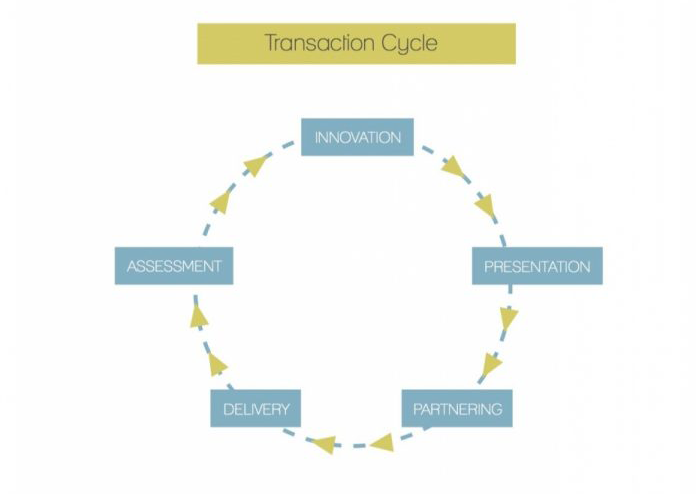
If you were to manage a project like the one we just analyzed, the first thing you would do is to identify where you individually perform at your best.
Which phases feel most intuitive and natural to you? Which phases feel like real work? Rank-order the five phases, one being where you are strongest, then two, three, four, and five.
When work is fun, you’re tapping into natural personality strengths.
This is where you should focus your individual efforts and where you will be adding strategic value. Expertly deliver the other phases of the project by assembling a team whose strengths are complementary to yours and align with the phases you rank low.
Our coaching recommendation is always to structure your career and activities around the phases that best leverage your strengths. Build partnerships or delegate out the other phases of the transaction cycle; especially tasks associated with the phases you ranked four and five.
Many professionals lack a big picture business perspective. They think tactically as opposed to strategically. This is often why breakdowns occur. People are not in the right role based on their strengths.
If you’re not yet getting a seat at the table, put into practice what you are learning about yourself and others in TLT Coaching. You will begin to get noticed when you are able to drive successful outcomes by understanding the big picture.